
Roofing Advice
How Long Does a Flat Roof Last?
There is no single number that answers how long a flat roof lasts, and anyone who quotes you one figure regardless of the roof is oversimplifying. Two flat roofs finished in the same material, on similar houses, can perform very differently depending on how they were built, detailed and maintained.
This guide explains what genuinely decides how long a flat roof lasts — installation quality, deck condition, falls and drainage, detailing at upstands and penetrations, exposure, and maintenance — and what to look out for from inside the house, without ever needing to climb onto the roof yourself.
If you already suspect a problem, our roof repairs and leaking roof repairs pages cover what to do next. This page is about understanding what shapes a flat roof's working life in the first place.
- No material label guarantees a fixed lifespan on its own
- Installation quality and drainage matter more than which system is used
- Some warning signs can be spotted safely from inside the house
Looking for the service itself? Flat Roofing in Dublin
Why there is no single answer
Flat roofs are frequently discussed as if the covering material alone determines how long they last. In reality, the material is only one part of a system that also includes the deck underneath it, the falls that carry water to the outlets, the way upstands and penetrations are detailed, and how the roof has been maintained since installation.
Two roofs finished in exactly the same felt or GRP system can have very different working lives if one was installed onto a sound, well-fixed deck with correct falls and the other was laid over a marginal deck with poor drainage. This is why we avoid quoting lifespan numbers without qualifying them heavily — a figure given in isolation is more likely to mislead than help.
Felt roofing: built-up and torch-on systems
Felt is installed in bonded layers, with laps between sheets and details dressed into upstands, outlets and trims. It is one of the most established flat roofing systems used on Irish extensions, garages and outbuildings, and modern high-performance felts are a considerable step up from the thin single-layer felt seen on older garage roofs.
As a general guide only, well-installed modern felt systems are often discussed in terms of a couple of decades of useful service, though this is not a guarantee and depends heavily on the points below. Poor lap bonding, inadequate falls or a deck that was already damp at installation can all shorten that considerably. See felt roofing for more detail.
GRP and fibreglass roofing
GRP is applied wet as a glass-reinforced polyester laminate over a prepared deck, curing into a seamless covering with no joints across the roof area. Because it is unforgiving about substrate quality, a GRP roof that was properly re-decked and prepared before installation tends to hold up considerably better than one laid over a marginal base.
As a broad and indicative guide, properly installed GRP is often discussed in similar general terms to good-quality felt, again heavily dependent on preparation, detailing and drainage rather than the material name alone. See GRP fibreglass roofing.
EPDM rubber roofing
EPDM is a synthetic rubber membrane, often installed as a single sheet on domestic-sized roofs, which minimises joints and gives it good flexibility to accommodate movement in the deck below.
It suits straightforward rectangular roofs particularly well. Where a roof has many penetrations or complex upstands, every one of them needs individual detailing, and the quality of that detailing — not the membrane itself — tends to be what decides whether problems show up early. See EPDM roofing.
Liquid roofing systems
Liquid systems are applied cold, typically with a reinforcing fleece, and cure to form a seamless membrane that follows the shape of whatever it is applied over. Their real strength is dealing with awkward details: upstands, pipe penetrations, plant bases and refurbishment over existing coverings where conditions allow.
Performance depends heavily on substrate preparation and applying the correct thickness. A liquid system applied too thinly, or over a substrate that was not properly prepared, will not perform to the standard the product is capable of. See liquid roofing.
Installation quality decides more than the material label
Across all four systems, the pattern is the same: a flat roof that fails early almost always fails because of a decision made at installation, not because the material itself was inherently short-lived. Falls that were too shallow, an outlet positioned badly, an upstand formed without enough upstand height, or a covering laid over a deck that was already wet — these are the recurring causes.
This is also why patch repairs on an old flat roof are worth thinking carefully about. A repair over a deck that is already failing, or over falls that were never adequate, buys some time but does not address why the roof is struggling in the first place. Our flat roof types guide covers how the systems compare, and flat roof cost guide explains what drives replacement pricing.
Deck condition, falls and drainage
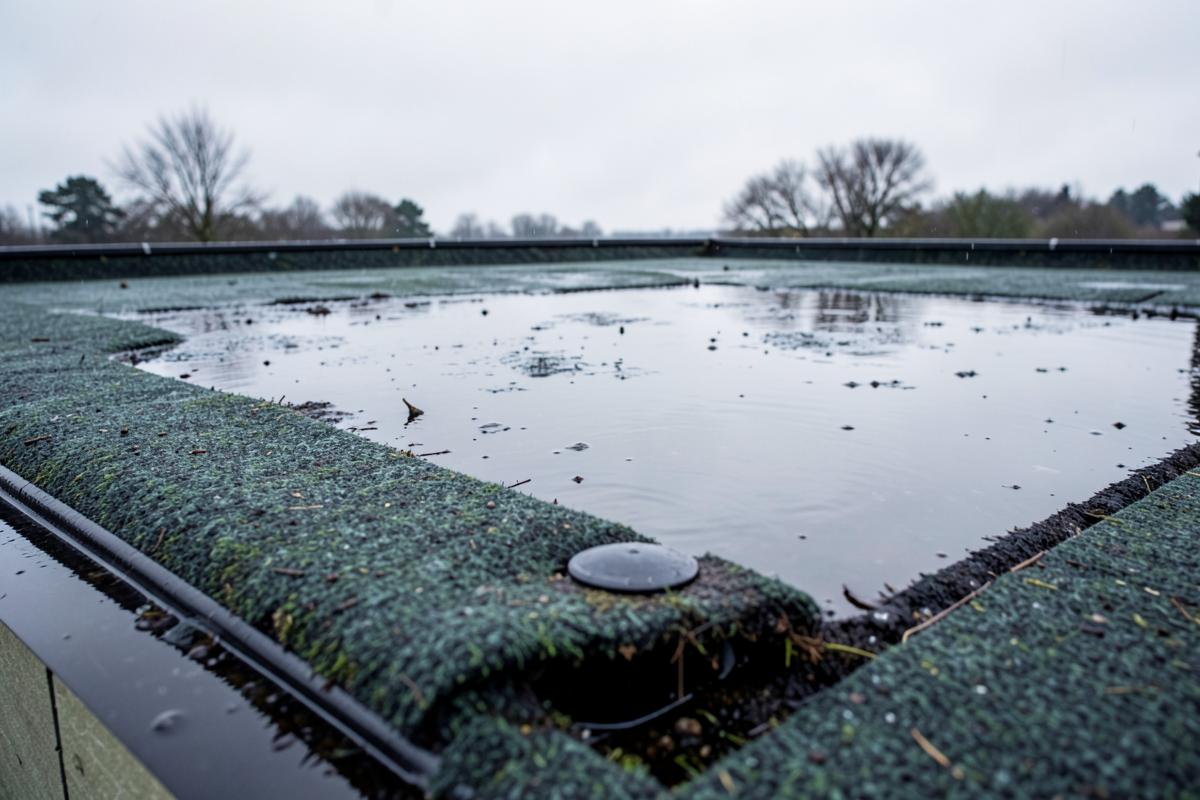
A flat roof is never actually flat; it needs a fall towards its outlets so that water drains away rather than sitting on the surface. Ponding water — water that sits for more than a short period after rain — is one of the most common reasons any flat roof system deteriorates faster than it should, regardless of the covering. Our flat roof ponding water guide covers this specifically.
The deck itself matters just as much. A softened, damp or poorly fixed deck undermines whatever covering sits on top of it, and no membrane can fully compensate for a deck that is already failing structurally.
Exposure and how the roof is used
Roofs exposed to standing water, heavy shading and damp conditions, or repeated foot traffic they were not designed for, tend to show wear sooner than sheltered, well-drained roofs used only for weatherproofing. If a flat roof is intended to be walked on as a balcony or terrace, that needs to be part of the original specification, not an assumption made afterwards.
Storm events can also accelerate wear on an otherwise sound flat roof, particularly where debris has damaged the surface or lifted a detail at an upstand. See storm damage if you suspect a recent event has affected the roof.
Maintenance and previous repairs
Flat roofs are not maintenance-free, whatever system they use. Keeping outlets and gutters clear, removing debris and moss build-up, and having the roof looked at periodically all extend a roof's realistic working life. A roof inspection every few years, or after any significant storm, tends to catch small issues before they become bigger ones.
Where a flat roof has already been patched more than once in the same area, that is usually a sign the underlying cause — often falls, an outlet, or a deck issue — has not actually been resolved. Repeated patching in the same spot is one of the clearer signals that a fuller repair, or eventual replacement, is worth discussing. See roof repair vs replacement.
Signs a flat roof may need attention
You do not need to get onto a flat roof to notice most of the early warning signs — several of them are visible from a window overlooking the roof, or from inside the property below it. Never attempt to walk onto or climb onto a roof yourself; if you want a closer look, arrange a professional inspection instead.
What to look out for
- Damp patches, staining or a musty smell on a ceiling below a flat roof — see water coming through ceiling
- Water that is still sitting on the roof surface a day or more after rain has stopped, visible from an upstairs window
- Blistering, splitting or cracking on the surface, visible from a window looking down onto the roof
- Coverings or trims that appear to be lifting at an upstand, edge or junction
- Debris or leaves visibly blocking an outlet or gutter at the edge of the roof
- An area that has clearly been patched before and appears to be leaking again
- Sagging or a dip in the roof line visible from an angle where it can be seen from ground or window level
What to do if you notice a problem
If you spot any of the signs above, the sensible next step is a proper look at the roof rather than guessing at the cause. A roof inspection identifies whether the issue is localised — a blocked outlet or a lifted detail — or a sign of wider deterioration across the covering or deck.
If water is actively coming through and causing damage inside, that becomes urgent rather than something to monitor. Our emergency roof repairs service is available for situations that cannot reasonably wait for a scheduled visit.
Get a price for your own roof
The only accurate figure is one based on your roof. Request a quotation or call Vantage Roofing and we will tell you what is involved.
Related Services
The roofing work behind this guide
Dublin city and county is our main service area, with additional coverage across Kildare, Meath and Wicklow.
Flat Roofing
Flat roof repairs and replacement on extensions, dormers, garages and porches across Dublin.
Learn moreFelt Roofing
Felt flat roof repairs and replacement for garages, extensions, porches and outbuildings.
Learn moreGRP & Fibreglass Roofing
Installation and repair of GRP fibreglass flat roofs on extensions, garages, porches and dormers.
Learn moreEPDM Roofing
EPDM rubber flat roofing installed, repaired and replaced on extensions, garages and dormers.
Learn moreLiquid Roofing
Liquid-applied roof waterproofing for flat roofs, complex details, upstands and awkward junctions.
Learn moreRoof Repairs
Repairs to slate, tile and flat roofs — from a handful of slipped slates to recurring leaks.
Learn moreRoof Inspections
A proper look at the roof and attic with a clear summary of roofing condition and recommended work.
Learn moreFAQ
How Long a Flat Roof Lasts — common questions
Which flat roof material lasts the longest?
There is no reliable answer to that in isolation. Installation quality, deck condition, drainage and maintenance affect a flat roof's working life more than which material was used. We assess each roof individually rather than quoting a general figure.
Is it normal for water to sit on a flat roof after rain?
A small amount briefly after heavy rain can be normal, but water still sitting on the surface a day or more later usually points to inadequate falls or a blocked outlet, and is worth having checked.
Can a flat roof be repaired instead of replaced?
Often yes, particularly where the issue is localised and the rest of the covering and deck are sound. Where an area has already been patched repeatedly, that usually indicates an underlying cause that a patch alone will not fix.
Does a flat roof need regular maintenance?
Yes. Keeping outlets and gutters clear of debris and having the roof looked at periodically, especially after storms, helps catch small problems before they lead to leaks or bigger repairs.
How can I check my flat roof without climbing onto it?
Look for warning signs from a window that overlooks the roof, or for damp and staining on ceilings below it. Do not attempt to walk on or climb onto any roof yourself; arrange a professional inspection if you have concerns.
Does the weather affect how long a flat roof lasts?
Yes. Exposure to standing water, prolonged damp, shading and storm events can all accelerate wear, particularly where drainage or detailing was already marginal.
More Guides
Other cost and decision guides
- Comparison GuideFlat Roof Types: Which Roofing System Is Right for Your Property?Read the guide
- Cost GuideFlat Roof Repair & Replacement Costs in DublinRead the guide
- Comparison GuideFelt vs Fibreglass Roofing: Which Is Better for Your Flat Roof?Read the guide
- Roofing AdviceHow Long Does a Roof Last in Ireland?Read the guide
Talk to a roofer
Need a Roofer in Dublin?
Need help with a roof repair, leak or roofing project? Call Vantage Roofing or request a quotation online. Fully insured, with 24/7 emergency roof repair call-outs.