
Roofing Problem
Why Is Water Pooling on My Flat Roof?
Water sitting on a flat roof normally means water is not reaching an outlet. That can be down to the falls built into the roof, a blocked or badly positioned outlet, a low spot where the deck or insulation has deformed, or debris holding water where it lands.
A shallow film of water after heavy rain that clears within a day or so is common on flat roofs and is not automatically a failure. Water that is still standing days later, in the same place every time, is worth investigating.
- Persistent ponding in the same place is the signal to act
- Ponding is a symptom — the cause may be falls, outlets or the deck
- Never walk out onto a flat roof to look
Looking for the repair work itself? Flat Roofing in Dublin
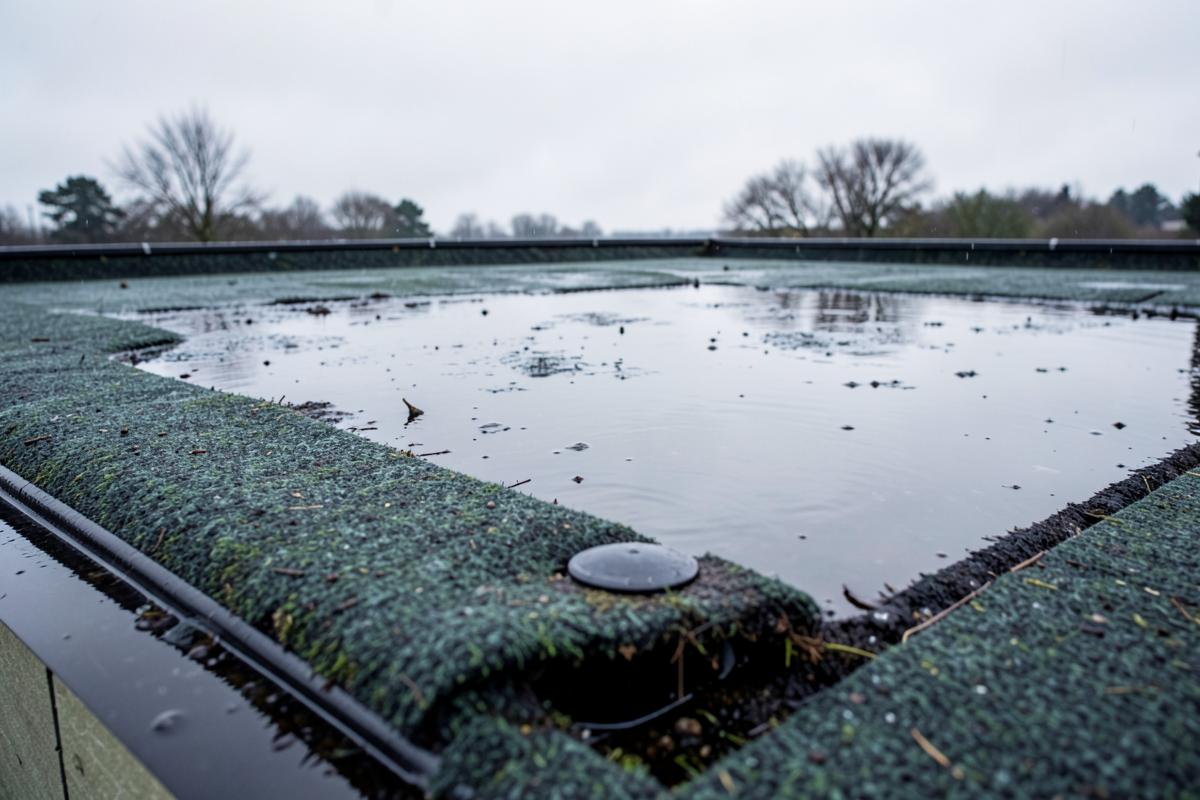
When ponding matters and when it does not
Flat roofs are not truly flat; they are laid to a shallow fall so water runs to an outlet. In practice, small amounts of temporary water after a downpour are normal, particularly on older roofs and around outlets.
What matters is persistence and position. Water that is still there long after the rain stopped, that reappears in exactly the same spot, that leaves a distinct tide mark of silt and growth, or that sits directly over an internal damp patch — that is the kind worth getting looked at.
Signs the ponding is a problem
- Standing water visible days after the last rainfall
- A defined dirt or algae ring marking a permanent pool
- Moss or plant growth establishing in the low area
- Blisters, splits, wrinkles or soft spots within the pooled area
- Water in the same area as internal staining below
- The roof surface feeling or looking noticeably dished from a window above
Possible causes
Possible causes include the following, and more than one commonly applies. A roof that started with modest falls and has since deflected slightly under load will pond far sooner than one laid with generous falls.
What we look at
- Falls that are insufficient, uneven or running towards the wrong place
- Outlets, gullies and rainwater shoes blocked with leaves, moss or grit
- An outlet set too high relative to the finished surface
- Local deflection of the deck, joists or insulation creating a hollow
- Compression or movement where the deck has taken water in the past
- Debris collecting behind upstands, kerbs, rooflights or plinths
- Deterioration of the covering itself in the pooled area — see flat roofing
- Gutters and downpipes serving the roof unable to take the flow — see guttering
What persistent ponding can do to a flat roof
Standing water is not an instant failure, but it does accelerate whatever weaknesses exist. Seams, laps and detail joints spend far longer submerged than the rest of the roof. Silt and organic growth build up and hold moisture against the covering. In freezing conditions, water that is already sitting in a hollow works at any small opening.
Where water has already got past the covering, saturated insulation and a soft deck can make the hollow deeper, so the ponding worsens over time. That is the point at which a localised repair may no longer be enough.
How the covering affects the options
The system on the roof affects what can sensibly be done, which is why we identify it before recommending anything.
Systems we work with
- Felt roofing — laps, blisters and aged surfaces around a pool are the usual concern
- GRP and fibreglass — joints, upstands and trims need checking where water sits
- EPDM rubber — generally tolerant of water, but seams and detail bonds still warrant inspection
- Liquid-applied systems — coating thickness and detailing around outlets matter most
- If you are weighing up which system suits the roof, see our guide to flat roof types
Putting the drainage right
Where the covering is sound and the issue is drainage, clearing and freeing outlets, reworking an outlet detail or forming a local fall can be enough. Where the deck or insulation has deformed and the covering is tired, correcting the build-up as part of a re-cover is usually the more durable answer.
We assess the roof type, condition, access and scope of work before recommending an approach, and we will not push a full replacement where the roof does not need one. Our flat roof cost guide explains what drives the price either way.
What not to do
- Do not walk out onto a flat roof to look at or clear the water — wet coverings are slippery and a saturated deck may not be sound underfoot
- Do not drill or cut a hole to let water out
- Do not coat over a pooled area with a shop-bought sealant while water is still present
- Do not assume ponding alone means the roof has failed
How we assess a ponding flat roof
1.Establish where water collects and for how long
The position and persistence of the pool, plus any tide marks, tell us whether we are looking at falls, an outlet or a hollow.
2.Check outlets and rainwater goods
Blocked or high-set outlets are a common and straightforward cause, so they get ruled in or out early.
3.Assess the covering and the deck
Condition of laps, seams, upstands and trims, and whether the area underfoot indicates saturated insulation or a soft deck.
4.Set out the options in writing
Localised repair and drainage correction, or re-covering with the build-up corrected — with what each involves made clear.
Get the roof looked at
Vantage Roofing works across Dublin city and county, with additional coverage in Kildare, Meath and Wicklow. 24/7 emergency roof repair call-outs available.
Related Services
The roofing work this usually leads to
Which of these applies depends on what the inspection finds — we will tell you plainly.
Flat Roofing
Flat roof repairs and replacement on extensions, dormers, garages and porches across Dublin.
Learn moreFelt Roofing
Felt flat roof repairs and replacement for garages, extensions, porches and outbuildings.
Learn moreGRP & Fibreglass Roofing
Installation and repair of GRP fibreglass flat roofs on extensions, garages, porches and dormers.
Learn moreLeaking Roof Repairs
Tracing the true source of a leak and repairing it properly, rather than patching where the stain appears.
Learn moreRoof Inspections
A proper look at the roof and attic with a clear summary of roofing condition and recommended work.
Learn moreWhere we cover
Dublin city and county is our main service area, with additional coverage across Kildare, Meath and Wicklow.
FAQ
Ponding Water on a Flat Roof — common questions
Is standing water normal on a flat roof?
A small amount of water after heavy rain that drains away within a day or so is common and not automatically a defect. Water still standing days later, in the same place each time, is worth having looked at.
Can ponding water damage a flat roof?
It can accelerate deterioration. Seams and details spend longer submerged, silt and growth hold moisture against the surface, and freezing conditions work at any small opening. Whether damage has occurred depends on the covering and its condition.
Why is my flat roof not draining?
Common reasons include a blocked or high-set outlet, insufficient or uneven falls, and a hollow where the deck or insulation has deflected. Often it is a combination, which is why the roof is assessed rather than assumed.
Does ponding mean the roof needs replacing?
Not on its own. Where the covering is sound, freeing the drainage or correcting a detail can be enough. Replacement comes into consideration where the deck or insulation has taken water and the covering is at the end of its life.
Should I clear the water off myself?
Please do not go onto the roof. Wet flat coverings are slippery and a deck that has taken water may not be safe to stand on. Clearing outlets is part of a normal inspection visit.
Talk to a roofer
Need a Roofer in Dublin?
Need help with a roof repair, leak or roofing project? Call Vantage Roofing or request a quotation online. Fully insured, with 24/7 emergency roof repair call-outs.