
Roofing Problem
Why Does My Roof Leak After Heavy Rain?
A roof that stays dry in ordinary showers and leaks in heavy rain is not a roof with no defect. It is a roof with a defect that only gets overwhelmed once enough water, or enough wind-driven water, is thrown at it.
Volume and direction are the two things that change in heavy weather. More water than a valley, gutter or outlet can carry will back up; wind pushes rain sideways and upwards into details designed to shed water running downwards.
- Intermittent leaks are still worth investigating
- Wind direction often identifies which detail is failing
- 24/7 emergency roof repair call-outs available
Looking for the repair work itself? Leaking Roof Repairs in Dublin
If water is coming in right now
An intermittent leak becomes urgent the moment water is actively entering the house.
- Keep away from any water near light fittings, switches or wiring, and do not use that circuit.
- Do not go onto the roof during or after a storm — that is when roofs are at their most dangerous.
- Call us on the number above. Emergency roof repair call-outs are available 24 hours a day, 365 days a year — see emergency roof repairs.
Wind-driven rain
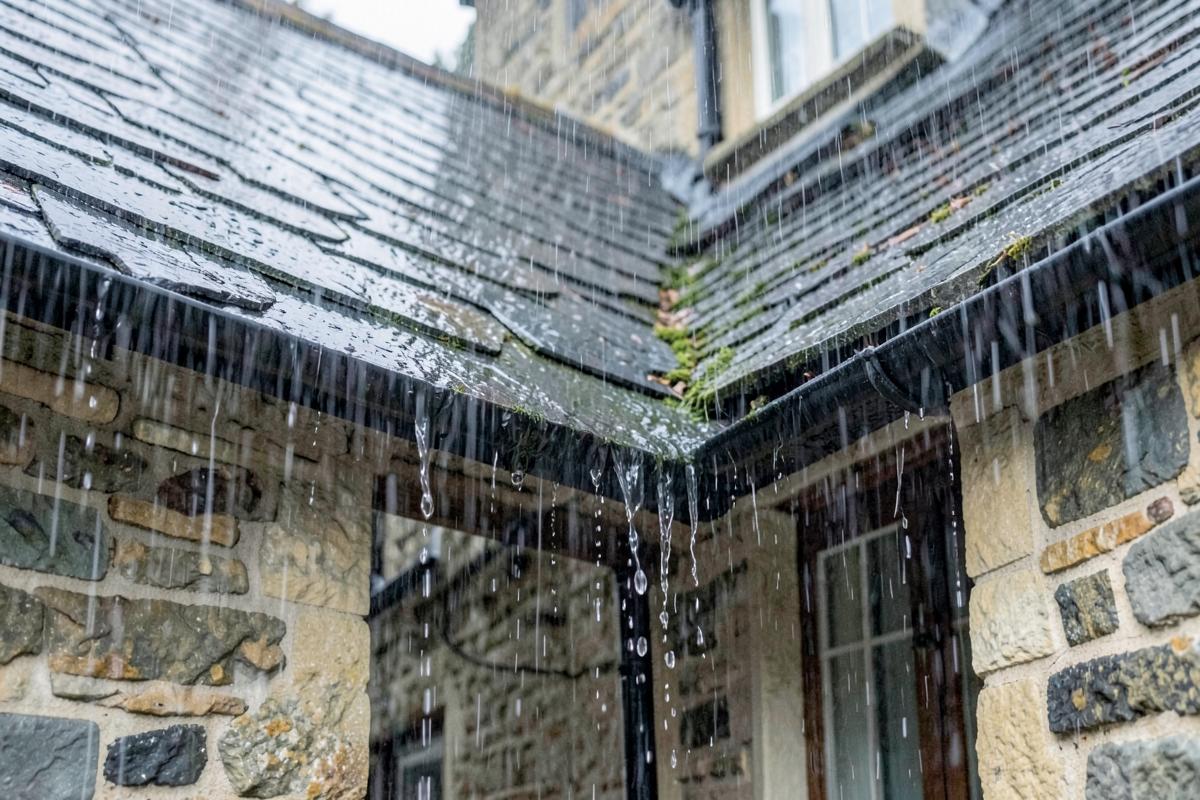
Irish weather rarely delivers rain straight down. Driven at an angle, water can be pushed up under the tail of a slate, in behind a flashing upstand, past a verge, or into a junction that works perfectly well in vertical rain.
This is why so many homeowners notice a leak only in certain storms, and not others of similar intensity. The variable is usually direction, not volume, and it is genuinely useful information — if the damp always follows a south-westerly, that narrows down which elevation to examine.
Drainage that cannot keep up
In prolonged heavy rain, everything designed to carry water away is working at capacity. Anything partially restricted then stops coping.
Where water backs up
- Valleys holding leaves, moss or grit, so water backs up under the coverings — see roof valley repairs
- Gutters and downpipes overflowing behind the fascia rather than discharging — see guttering
- Flat-roof outlets and gutters restricted by debris — see flat roofing
- Box gutters and back gutters behind chimneys filling faster than they drain
- Ground-level drainage backing up and being mistaken for a roof problem
Defects that only show under load
Plenty of roof defects are small. A hairline split in a lead flashing, a slate with a crack in it, a nail hole that has opened up, a lap in a valley that has lifted a few millimetres — each is capable of passing a trickle of water in a heavy downpour and nothing at all in light rain.
Common culprits
- Cracked, slipped or missing slates and tiles — see slate and tile repairs
- Split, lifted or poorly formed lead flashing
- Chimney junctions and deteriorated pointing — see chimney repairs
- Perished or torn underlay below the covering
- Failed laps, blisters or splits in a flat roof covering
- Detailing around roof windows — see Velux and skylight repairs
- Ridge, hip and verge details loosened by wind
Why intermittent leaks still need investigating
It is tempting to leave a leak that only appears two or three times a winter. The problem is what happens between appearances: water that gets in is soaking timber, underlay and insulation each time, and a defect that lets water past under load rarely gets smaller.
Intermittent leaks are also harder to trace the longer they are left, because by the time they become constant there may be several wet areas rather than one clear trail.
Tracing a leak that will not perform on demand
A roofer arriving on a dry day cannot watch your leak happen, which is the honest difficulty with intermittent ingress. What we can do is read the evidence it leaves: staining and tracking on the underlay, watermarks on rafters, debris lines in valleys and gutters, and the condition of each detail on the elevation the weather comes from.
Where the picture still is not clear, we will say so rather than replace details speculatively. Sometimes the right advice is to check again after the next heavy spell.
What not to do
- Do not go up to check the roof during or immediately after a storm
- Do not clear gutters or valleys from a ladder in wet or windy conditions
- Do not wait for the leak to become constant before having it looked at
- Do not let anyone replace flashings or coverings speculatively without evidence
How we approach an intermittent leak
1.Build the pattern
Which storms produce it, from which direction, how long after rain starts, and where it shows internally.
2.Read the attic evidence
Where there is access, dried tracking marks and stained timbers show the route water has been taking even on a dry day.
3.Inspect the exposed elevation first
Coverings, flashings, valleys, abutments and rainwater goods on the side the weather comes from.
4.Repair, then verify
We fix what we found and tell you what to watch for after the next heavy spell, rather than declaring the problem solved on a dry day.
Get the roof looked at
Vantage Roofing works across Dublin city and county, with additional coverage in Kildare, Meath and Wicklow. 24/7 emergency roof repair call-outs available.
Related Services
The roofing work this usually leads to
Which of these applies depends on what the inspection finds — we will tell you plainly.
Leaking Roof Repairs
Tracing the true source of a leak and repairing it properly, rather than patching where the stain appears.
Learn moreRoof Repairs
Repairs to slate, tile and flat roofs — from a handful of slipped slates to recurring leaks.
Learn moreRoof Valley Repairs
Repairs to leaking, blocked and deteriorated roof valleys, including the slates and flashing either side.
Learn moreLead Flashing
Repairing and renewing flashing at chimneys, wall abutments, valleys and roof junctions.
Learn moreChimney Repairs
Roofing repairs around chimney stacks — flashing, junctions, mortar and the surrounding roof covering.
Learn moreFlat Roofing
Flat roof repairs and replacement on extensions, dormers, garages and porches across Dublin.
Learn moreWhere we cover
Dublin city and county is our main service area, with additional coverage across Kildare, Meath and Wicklow.
FAQ
Roof Leaking After Heavy Rain — common questions
Why does my roof only leak during heavy rain?
Because the defect is small enough to cope with light rain but not with the volume or direction of a downpour. Overwhelmed drainage, wind-driven water and minor splits in coverings or flashings are the usual explanations.
Can wind-driven rain expose a roofing defect?
Yes. Rain driven at an angle can get in under slate tails, behind flashings and past verges that shed vertical rain perfectly well. Leaks tied to one wind direction usually point to that elevation.
Should an intermittent roof leak be inspected?
It should. Every time it happens, water is soaking timber and insulation, and defects of this kind tend to worsen. It is also easier to trace while the evidence is confined to one area.
Could it be the gutters rather than the roof?
Quite possibly. Overflowing or blocked gutters, and downpipes that cannot keep up, push water back into the fascia and wall in heavy rain. It is one of the first things we check.
Can you find a leak on a dry day?
Usually. Water leaves tracking marks and staining on underlay and timbers, and the failing detail can generally be identified on inspection. Where it genuinely cannot, we will tell you rather than guess.
Talk to a roofer
Need a Roofer in Dublin?
Need help with a roof repair, leak or roofing project? Call Vantage Roofing or request a quotation online. Fully insured, with 24/7 emergency roof repair call-outs.