
Roofing Problem
What Does a Sagging Roof Mean?
A visible dip, sag or uneven line in a roof means something in the roof has moved or deflected. Possible factors include long-term loading, deterioration of timber or fixings, moisture-related damage, problems with the covering, or an underlying structural issue.
We cannot tell you which of those applies from a photograph or a description, and neither can anyone else. What we can say is that a noticeable change in a roofline is worth having assessed rather than watched.
- Several different causes can produce the same visible sag
- Significant structural concerns need an appropriately qualified structural professional
- Never climb onto a roof that is visibly sagging or damaged
Looking for the repair work itself? Roof Inspections in Dublin
Important — the limits of what a roofer can tell you
Vantage Roofing is a roofing contractor. We do not provide structural engineering services or structural calculations.
- A roofing inspection can identify roofing-related defects and report on the condition of the covering, the details and, where there is access, the visible roof timbers.
- Where what we see suggests a significant structural concern, we will tell you plainly that an assessment by an appropriately qualified structural professional, such as a chartered structural engineer, may be needed.
- We will not diagnose structural failure, and we would be wary of anyone who does so without a proper structural assessment.
- If a roof, ceiling or structure appears at risk of collapse, keep people out of the affected rooms and seek appropriate professional assistance without delay.
What you may be noticing
Roof sag is usually spotted from across the road, or in a photograph, rather than up close. A straight edge helps: ridges and eaves lines were built straight, so a visible curve is a real change.
Signs worth recording
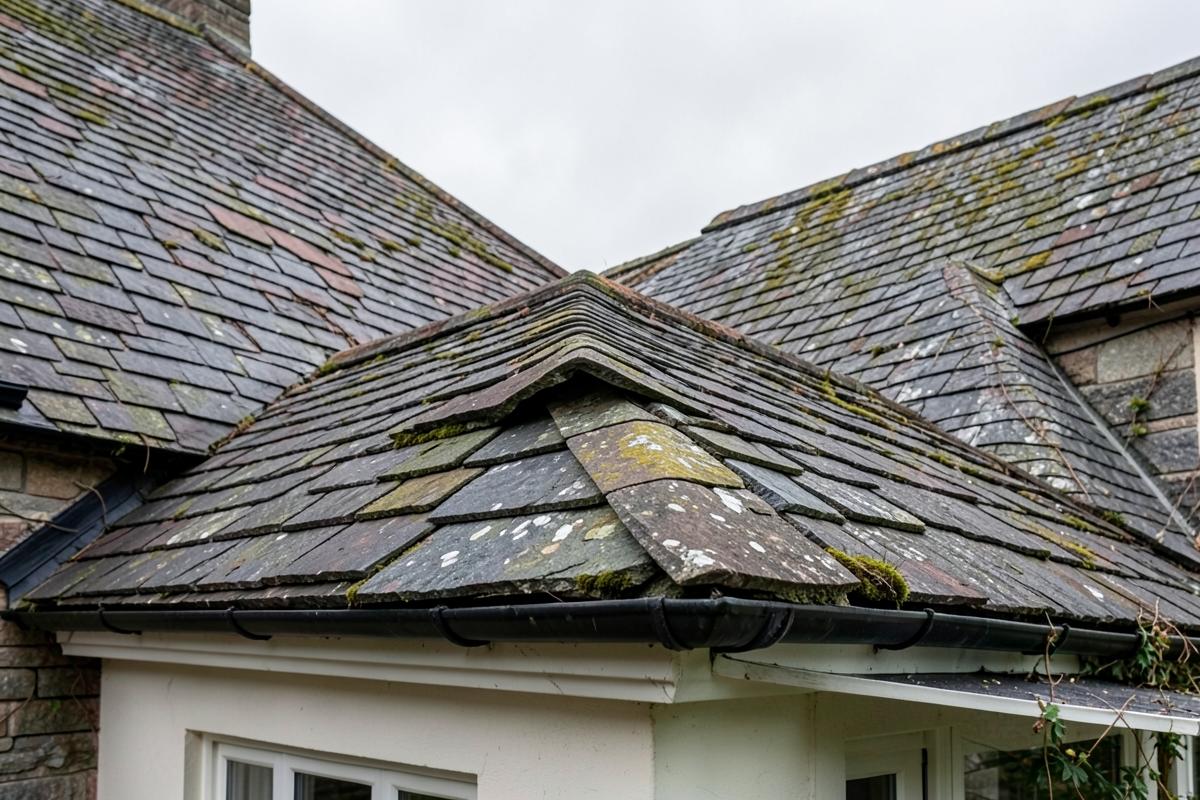
- A dip or curve along the ridge line
- A slope that looks hollow or wavy rather than flat
- The eaves or verge line no longer running straight
- Slates or tiles opening up, riding or sitting unevenly in one area
- Gaps appearing at a ridge, hip or against a party wall
- Doors or ceilings in the rooms below behaving differently than before
- Whether the shape has changed recently or has looked like that for years
Possible contributing factors
Possible causes include the following, singly or in combination. Older roofs in particular can show a gentle settled curve that has been stable for decades, while a new or worsening sag is a different matter.
What may be involved
- Long-term deflection of roof timbers under sustained load
- Additional weight the roof was not originally built for — for example a heavier covering laid over a lighter one
- Deterioration of timber where water has been getting in over a long period
- Weakened, corroded or failed fixings and connections
- Alterations within the roof space, such as timbers cut or removed during earlier work
- Movement or deterioration in the supporting structure below the roof
- Damage to the covering itself making an otherwise sound slope look uneven
Is it new, or has it always been like that?
This matters more than almost anything else. An old roof with a settled curve that appears in twenty-year-old photographs of the house is a different situation to a dip that has appeared or deepened in the last couple of winters.
Old photographs, a neighbour's memory of the house or an estate agent's listing image can all help establish whether the shape is changing. If it is, that should be assessed rather than monitored casually.
What a roofing inspection can tell you
A roof inspection looks at the condition of the covering, the details and the visible roof structure where there is safe access to the roof space. It can identify roofing defects, water ingress, deteriorated timber that is visible, and whether the covering appears to have been changed.
That is often enough to establish whether the problem is roofing-related and repairable, or whether it needs a structural professional's involvement before anyone considers roofing work. We would rather tell you that than quote for a re-roof over a structure nobody has assessed.
Where roofing work does come into it
Where the sag is limited, the structure is confirmed to be sound and the problem is with the covering or localised timber, roof repairs may be the right answer.
Where the covering has reached the end of its life and the roof needs stripping in any case, a new roof or slate roof replacement is the point at which underlying timber can be seen properly and put right. Whether that is appropriate depends entirely on what the assessment finds.
What not to do
- Do not climb onto a roof that is visibly sagging, damaged or has taken water
- Do not store anything heavy in the attic above the affected area
- Do not cut, move or notch roof timbers to make space
- Do not accept a diagnosis of structural failure — or an all-clear on the structure — from anyone not qualified to give one
- Do not put a new covering onto a roof whose structure has not been properly assessed
How we approach a sagging roof
1.Look at the roof from a distance
Ridge, eaves and verge lines against the rest of the building tell us where the deflection is and how extensive it is.
2.Inspect the roof space where accessible
Condition of visible timbers, evidence of long-term water ingress, and any sign that the roof has been altered or re-covered.
3.Assess the covering and details
Whether the covering, its weight and its condition are contributing, and whether water has been getting in for a long period.
4.Say clearly what is needed next
Either roofing work we can scope and quote, or a recommendation to involve an appropriately qualified structural professional first.
Get the roof looked at
Vantage Roofing works across Dublin city and county, with additional coverage in Kildare, Meath and Wicklow. 24/7 emergency roof repair call-outs available.
Related Services
The roofing work this usually leads to
Which of these applies depends on what the inspection finds — we will tell you plainly.
Roof Inspections
A proper look at the roof and attic with a clear summary of roofing condition and recommended work.
Learn moreRoof Repairs
Repairs to slate, tile and flat roofs — from a handful of slipped slates to recurring leaks.
Learn moreNew Roofs & Roof Replacement
Full re-roofing and roof replacement, where repairs are no longer a sensible long-term option.
Learn moreSlate Roof Replacement
Re-slating and full slate roof replacement where a covering has reached the end of its useful life.
Learn moreWhere we cover
Dublin city and county is our main service area, with additional coverage across Kildare, Meath and Wicklow.
FAQ
Sagging Roof — common questions
Is a sagging roof dangerous?
It can be, and it depends entirely on the cause and the extent. A long-settled curve on an old roof may be stable; a new or worsening dip should be assessed promptly. If any part of a roof or ceiling appears at risk of collapse, keep people out of the area and seek professional assistance straight away.
Can a sagging roof be repaired?
Sometimes, depending on what is causing it. Roofing-related problems with the covering or localised deteriorated timber can often be put right. Where the cause is structural, the structural issue has to be addressed by the appropriate professional before roofing work is planned.
Who should inspect a sagging roof?
A roofing contractor can inspect the covering, the roofing details and the visible roof timbers, and tell you whether the problem looks roofing-related. Where there is a significant structural concern, an appropriately qualified structural professional should assess it. We are roofers and we will say when a job is outside that.
Does a sagging roof always need replacing?
No. Replacement becomes relevant when the covering has failed or when stripping the roof is needed to reach and repair what is underneath. It is not an automatic answer to a dip in a roofline.
Can a heavier covering cause a roof to sag?
Weight is one of several factors that can contribute, particularly where a heavier covering has been laid on a roof originally built for a lighter one. Establishing whether that has happened is part of inspecting the roof space.
Talk to a roofer
Need a Roofer in Dublin?
Need help with a roof repair, leak or roofing project? Call Vantage Roofing or request a quotation online. Fully insured, with 24/7 emergency roof repair call-outs.