
Roofing Problem
Loose or Cracked Ridge Tiles: What to Do
Ridge tiles sit along the apex of a pitched roof and, on most older Irish houses, they are held there by mortar. Mortar is the part that ages. Once it has cracked and lost its grip, the ridge pieces are relying on their own weight in a country that gets Atlantic wind several times a winter.
A loose ridge tile is a genuine hazard as well as a leak path, because it falls a long way onto a footpath, a car or a garden. It is one of the few roofing faults where the urgency is about safety as much as water.
- Mortar bedding fails with age, frost and movement — that is normal, not neglect
- A loose ridge piece can be blown off in the next spell of wind
- You can see most of the warning signs from the ground with binoculars
Looking for the repair work itself? Dry Ridge & Dry Verge in Dublin
If something is visibly loose or has already fallen
Treat the ground below the ridge line as the risk area until a roofer has been.
- Keep people, cars and bins away from the ground directly below a ridge piece that is out of line or visibly lifting.
- If a ridge or hip tile has already come down, that is rarely the only one that has let go. The rest of the run needs checking.
- Do not go up to push a ridge tile back or weigh it down. Ridge work is right at the apex, on the least forgiving part of a roof.
- If material is loose above a public footpath or a shared entrance, treat it as urgent — emergency roof repairs exist for exactly this.
Why bedding mortar lets go
A traditional ridge is bedded in sand and cement along the top course of the covering. It is a good system and it has held Irish roofs together for a century, but mortar is rigid and a roof is not. Timber moves with heat and moisture, water gets into hairline cracks and freezes, and each winter opens the crack a little further.
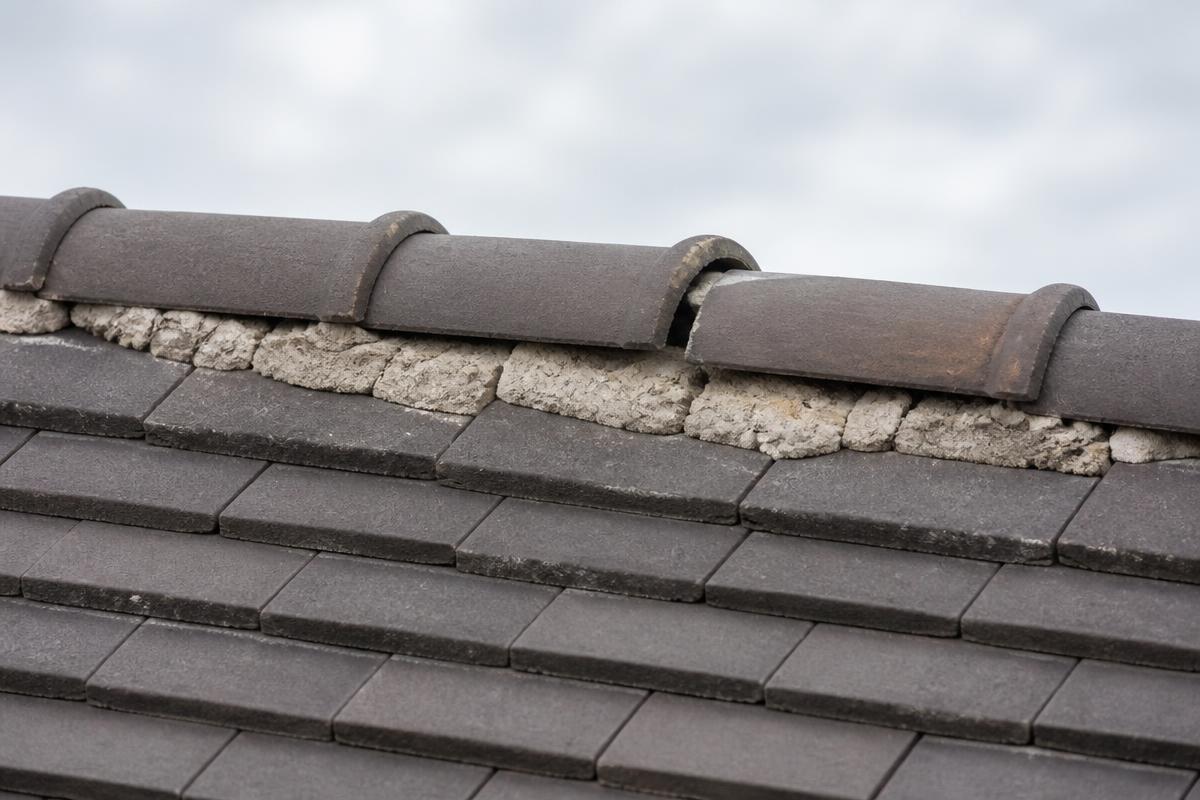
Given enough of that, the mortar gives way. You will often see it crumbling out in sections along one side of the ridge, or missing entirely where a hip meets the eaves. Nobody did anything wrong — bedding mortar is simply one of the shorter-lived parts of a roof, and how long it lasts on any particular roof depends on the exposure and the original work.
What you can safely see from the ground
Stand back across the road or at the end of the garden on a bright day, with the sun behind you. A pair of binoculars is genuinely the most useful roofing tool a homeowner can own.
Signs worth reporting
- A ridge or hip tile sitting higher, lower or out of line with the ones beside it
- A visible gap where you can see daylight or shadow under a ridge piece
- Mortar missing in sections, or a pale crumbly line where it has eroded back
- Pieces of mortar in the gutter, on a flat roof below, or on the ground after wind
- A cracked ridge tile, or one with a corner broken away
- Vegetation or moss growing out of the ridge joint, which means the joint is open
- Staining on the ceiling of an upstairs room close to the ridge line
Ridges, hips and verges
The same failure happens in three places and the consequences differ. The ridge is the horizontal apex. Hips are the sloping edges where two slopes meet on a hipped roof, and hip tiles are the ones most often displaced, because they sit on a slope and the bottom one carries the run. The verge is the gable edge, traditionally mortared, and verge mortar is usually the first mortar on any roof to crack.
A roofer should tell you which of the three is actually failing on your house and whether the rest of the run is sound, rather than quoting for the whole lot by default.
Wind, storms and why ridges go first
Wind does not simply push on a roof; it lifts. The ridge and hips sit along the most exposed lines of a roof, so a ridge piece whose bedding has already failed is often among the first things to move in a storm. Storm call-outs can involve displaced ridge or hip tiles, and a ridge that was already cracked in the autumn is often the one on the lawn after a winter gale.
Storm damage repairs covers the aftermath, and what to check after a storm covers what to look for once the weather passes.
Re-bedding, or converting to dry ridge
There are two sensible ways to put a failed ridge right, and which suits your roof depends on the roof.
Re-bedding means removing the ridge pieces, cleaning off the old mortar and bedding them back in fresh mortar, usually with mechanical fixing where appropriate. It keeps the traditional appearance, which matters on period and slate roofs, and it is often the right answer where the existing ridge tiles are sound and worth reusing.
A dry ridge system replaces the mortar with a ventilated roll and mechanical fixings, so each ridge piece is screwed down rather than bedded down. It does not depend on mortar that can crack and weather, it allows the ridge to ventilate, and it accommodates the movement that broke the bedding in the first place. Dry ridge and dry verge explains where each approach fits and what a conversion involves.
How urgent is it?
A hairline crack in otherwise sound mortar is something to plan for. A ridge piece that has visibly moved, a run with mortar missing in lengths, or anything sitting above a footpath is not — that is work to arrange before the next stretch of wind rather than after it.
Water ingress raises it again. A ridge is the highest point of the roof and water getting in there runs a long way before it appears, which is why the stain often shows up in a room that seems unrelated. Roof repairs and slate and tile repairs cover the work itself.
What not to do
- Go up to inspect, reposition or weigh down a ridge tile — this is the highest and most exposed point of the roof
- Smear sealant or mastic over a cracked ridge joint in the hope of buying a winter
- Leave a run where mortar is visibly missing until it becomes a storm call-out
- Assume one loose ridge tile is an isolated fault — bedding tends to fail along a length, not at a point
- Park underneath, or leave bins and garden furniture below, a ridge piece that has moved
How a failed ridge is assessed
Ridge work is priced by how much of the run has gone, so the assessment is about extent before it is about method.
1.Check the full run, not the obvious piece
Each ridge and hip tile is checked along its length. Bedding usually fails progressively, so the loose one is rarely alone.
2.Look at the condition of the tiles themselves
Cracked or broken ridge pieces cannot be reused, and matching a period or discontinued profile affects what is possible.
3.Check the top course below
Mortar failing at the ridge often means the slates or tiles in the top course have been getting wet for a while.
4.Look inside where there is attic access
Staining or damp on the rafters and underlay near the apex shows whether water has already been getting past.
5.Recommend re-bedding or dry ridge
We explain which suits your covering, the appearance you want to keep and the exposure of the roof, and why.
Get the roof looked at
Vantage Roofing works across Dublin city and county, with additional coverage in Kildare, Meath and Wicklow. 24/7 emergency roof repair call-outs available.
Related Services
The roofing work this usually leads to
Which of these applies depends on what the inspection finds — we will tell you plainly.
Dry Ridge & Dry Verge
Re-bedding failed ridge, hip and verge mortar, or converting to a mechanically fixed dry system.
Learn moreSlate & Tile Repairs
Replacing slipped, cracked and missing slates and tiles, plus ridge, hip and verge repairs.
Learn moreRoof Repairs
Repairs to slate, tile and flat roofs — from a handful of slipped slates to recurring leaks.
Learn moreStorm Damage Repairs
Assessment and repair of wind and storm damage, with photographs of the damage and completed work where appropriate.
Learn moreEmergency Roof Repairs
Urgent help for active roof leaks, storm damage and roofing problems that cannot safely wait — 24/7 call-outs.
Learn moreWhere we cover
Dublin city and county is our main service area, with additional coverage across Kildare, Meath and Wicklow.
FAQ
Loose Ridge Tiles — common questions
How do I know if my ridge tiles are loose?
From the ground with binoculars, look for a ridge piece out of line with its neighbours, a visible gap beneath one, mortar crumbling or missing along the run, and bits of mortar in the gutter or on the ground after wind. Never climb up to check by hand.
How long does ridge mortar last?
It depends on the mix, the exposure of the roof and how much the structure moves, so no honest figure covers every roof. What is consistent is that bedding mortar has a shorter working life than the covering it sits on, and it is normally the first part of a pitched roof to need attention.
Is a dry ridge better than mortar?
It does not rely on bedding mortar, and ventilated versions also allow the ridge to breathe where the system is designed for it. It is commonly specified on new tiled roofs and on re-roofing work. Mortar re-bedding still suits plenty of roofs, particularly period and natural slate roofs where appearance matters. The right answer depends on your roof rather than on the system.
Can just one ridge tile be re-bedded?
Sometimes, where the rest of the run is genuinely sound and the tile itself is undamaged. More often the mortar has gone along a length and patching one joint leaves the same failure either side of the new work. We will tell you honestly which situation yours is.
Is a loose ridge tile an emergency?
If it has visibly moved, sits above a footpath, entrance or parking area, or water is coming in, treat it as urgent. A hairline crack with everything still sitting square can be planned work. Emergency roof repair call-outs are available 24 hours a day.
Talk to a roofer
Need a Roofer in Dublin?
Need help with a roof repair, leak or roofing project? Call Vantage Roofing or request a quotation online. Fully insured, with 24/7 emergency roof repair call-outs.